Placemaking and Community-Driven Development in Texas: Beyond the Pro Forma
The Pro Forma Does Not Capture Everything That Matters
Real estate development has always been a quantitative discipline. Developers build financial models, underwrite assumptions, and make go/no-go decisions based on return thresholds. That discipline is necessary and will not change.
But the quantitative framework of a development pro forma has a significant blind spot: it does not capture the value created by exceptional placemaking — the design, programming, and community engagement decisions that transform a real estate project from a collection of square footage into a destination that people genuinely want to be in.
The evidence that placemaking generates measurable financial returns is substantial. Projects in Texas's urban markets that are recognized for exceptional placemaking — South Congress Avenue in Austin, Klyde Warren Park's immediate context in Dallas, Fort Worth's Near Southside — consistently outperform comparable projects on rent, occupancy, and long-term appreciation. The premium is real, and it is durable.
This article examines the principles of placemaking in the Texas development context, what community-driven development means in practice, and how Watershed applies these principles to the projects we advise.
What Is Placemaking?
Placemaking is a planning, design, and community development approach that capitalizes on a local community's assets, inspiration, and potential. The term was popularized by the Project for Public Spaces — a nonprofit organization that has documented and promoted placemaking principles since the 1970s — but the concept is ancient: it describes the human impulse to create environments that are meaningful, vibrant, and oriented to human experience rather than to vehicular movement and maximum buildable area.
In a real estate development context, placemaking encompasses:
- Physical design — the configuration of buildings, open spaces, streetscapes, and public areas that create memorable, human-scaled environments
- Tenant and use mix — the deliberate curation of uses that create activity and energy at different times of day
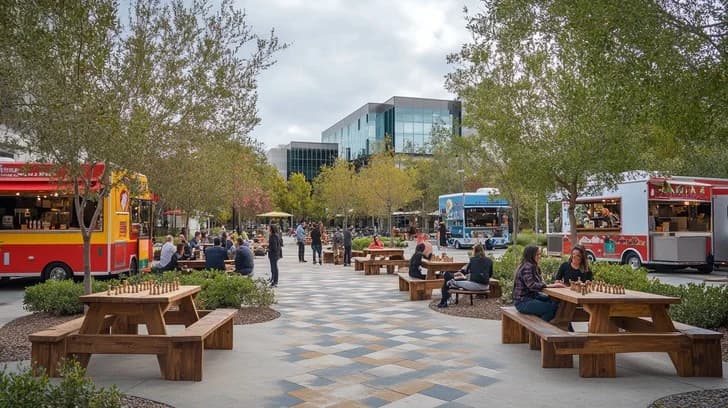
- Programming — the activation of outdoor and common spaces through events, markets, art installations, and community gatherings
- Community engagement — the process of understanding and incorporating the needs and aspirations of the existing community into the development vision
The common thread is that placemaking is about more than what is built — it is about what happens, and how it feels to be there.
Why Placemaking Matters in Texas's Urban Markets
Texas's most dynamic urban neighborhoods share a common characteristic: the places that people love — and that command premium rents — are the ones that feel like genuine places rather than interchangeable real estate products.
South Congress Avenue in Austin is a textbook example. The corridor's success is not a function of building quality alone — many of the buildings on South Congress are modest by any standard. It is a function of the accumulated character created by the mix of uses, the walkable streetscape, the independent businesses that give the corridor its identity, and the ongoing programming and activation that makes it a destination.
Deep Ellum in Dallas has undergone a dramatic revitalization over the past decade, driven by a combination of adaptive reuse development, arts programming, and a deliberately curated tenant mix that preserved the district's creative character even as real estate values escalated.
Fort Worth's Near Southside represents a third model — a neighborhood revitalization driven by a dedicated nonprofit organization (Near Southside Inc.) that has focused on placemaking and public realm investment as the engine of private development catalysis.
These are not accidents. They are the result of deliberate placemaking decisions made by developers, property owners, city agencies, and community organizations working in concert.
Community-Driven Development: The Process Dimension
Placemaking is not just a design philosophy — it is a process orientation. Community-driven development begins with listening before designing.
The conventional development process runs roughly as follows: developer identifies site, hires architects, develops program, submits entitlement applications, engages the public during a required notice and comment period, and then proceeds. Community input is reactive rather than generative — the community responds to what has already been designed rather than contributing to what gets designed.
Community-driven development inverts this sequence. The developer begins the project with a genuine engagement process — not to satisfy regulatory requirements, but to understand what the community needs, what it values, and what concerns must be addressed for the project to be welcomed rather than resisted.
Practical elements of community-driven development:
Early and genuine engagement: The developer convenes community meetings, one-on-one conversations with key stakeholders, and facilitated design workshops before a development program has been finalized. The output of this engagement informs program decisions — not just the color of the lobby walls.
Local economic integration: Community-driven projects prioritize local business tenancy, local contractors and subcontractors, local artists for public art commissions, and hiring from the immediate neighborhood where feasible. This creates genuine economic connections to the existing community and generates the kind of authentic tenant mix that cannot be manufactured through conventional leasing.
Long-term community benefit commitments: Many community-driven projects incorporate specific commitments to community benefit — affordable commercial spaces for local businesses, community gathering areas available for neighborhood programming, employment and workforce development commitments. These commitments, when genuine rather than performative, build the political goodwill that makes the entitlement process smoother and the ongoing operating environment more collaborative.
Ongoing programming and activation: The most successful community-driven developments maintain an active programming function throughout the project's operating life — farmers markets, outdoor events, arts installations, and community gatherings that keep the project engaged with its neighborhood and its neighborhood engaged with the project.
The Financial Case for Placemaking
Developers who are skeptical of placemaking sometimes characterize it as a cost center — money spent on community engagement, programming, and curated tenant mix that does not show up on the pro forma.
The evidence suggests the opposite.
Rent premiums: Projects with recognized placemaking attributes in Austin and DFW consistently achieve rent premiums of 10–25% over comparable projects without those attributes. These premiums are not just at initial lease-up — they are durable, because the placemaking qualities that attract tenants also retain them.
Lease-up velocity: Exceptionally programmed and designed projects typically achieve faster lease-up than conventional competitors. Slower lease-up is a real carrying cost; faster lease-up is real revenue. The economic value of 60 days of faster lease-up on a 200-unit project at $2,000 average rent is $2.4 million.
Entitlement process: Community-driven projects that have engaged meaningfully with their neighborhood typically face less entitlement opposition and shorter regulatory review processes than projects that have not. In Austin, where a contested Planning Commission case can add 6–12 months to a project timeline, the cost of community opposition is enormous. Authentic placemaking reduces that risk.
Exit pricing: The cap rate compression that applies to assets in recognized placemaking destinations — South Congress, Deep Ellum, Near Southside — is measurable. Investors pay premiums for assets in these locations because the placemaking creates a durable competitive moat that conventional competitors cannot easily replicate.
Placemaking at the Project Scale: Practical Principles
Not every development project can transform its neighborhood. But every project can contribute to its context — or detract from it. Several principles guide placemaking at the individual project level:
Ground floor activation: The single most important placemaking decision in an urban development project is the design and programming of the ground floor. Active uses — retail, food and beverage, services, community space — facing the street create the pedestrian activation that defines the character of a block. Parking structures, service areas, and blank walls do the opposite.
Public realm investment: The area between the building and the street curb — sidewalks, landscaping, seating, lighting — has a disproportionate impact on the street-level experience. Projects that invest meaningfully in public realm design beyond the minimum code requirements create environments that people actually want to inhabit.
Tenant curation over maximizing rent per square foot: The choice of ground floor tenants should be driven by their contribution to the project's character and activation, not solely by their rent-paying capacity. A locally-owned coffee shop or restaurant that draws neighborhood residents creates far more placemaking value than a national chain that pays 10% more rent but adds nothing to the project's identity.
Flexibility and adaptability: The most successful placemaking projects design spaces that can evolve — that can accommodate different programming, different uses, and changing community needs over time. Rigid building configurations and lease structures that prohibit programmatic flexibility are the enemy of long-term placemaking success.
Watershed's Approach to Placemaking Advisory
Watershed Development Group advises clients on placemaking strategy as an integrated component of our development consulting practice. We help developers:
- Design community engagement processes that generate genuine insight rather than checking a regulatory box
- Develop ground floor programming strategies that maximize placemaking impact while maintaining project economics
- Curate tenant mixes that create authentic district identity rather than generic retail assemblages
- Integrate public realm investments into project budgets and design programs
- Build the case for placemaking investments by quantifying the expected returns in rent premiums, lease-up velocity, and exit pricing
In Texas's most competitive urban markets, placemaking is not a nice-to-have. It is the difference between a project that achieves market rents and one that commands a premium — and between a development that defines a neighborhood and one that merely occupies space within it.
Contact Watershed Development Group to discuss how placemaking can improve the outcomes of your next Texas development project.
Watershed Development Group
Ready to Discuss Your Project?
Our team provides full-lifecycle development consulting services across Austin and the DFW metroplex. Let’s talk about what’s possible.
Contact Us